|
Scope
In the recent years,
several results in combinatorics and discrete mathematics have been obtained and advanced
through effective computations involving computer algebra and numerical methods,
such as kissing numbers and optimal sphere packings,
independence ratios and Lovasz numbers,
and graph homomorphisms.
Frequently, new progress relies on the exploitation of algebraic structure.
In our workshop, we want to focus on computational methods which use algebra and exploit symmetries to solve problems in graph theory.
Emphasize lies on sums of squares-based optimization hierarchies which make use of lattice-based symmetry exploitation, group actions or sparsity.
We aim to connect experts who are working on the intersections of combinatorics, optimization and algebra. This is foreseen to enable synergies and open opportunities for future work.
|
Lectures
Daniel Brosch:
Symmetric Term Sparsity -
TBA
Nidhi Kaihnsa :
Rational Univariate Representation in Reaction Networks -
TBA
Nando Leijenhorst:
Traceless projections of tensors with applications in discrete geometry -
A spherical code is a set of points on the sphere with a certain pair-wise minimum distance.
We find upper bounds on the maximum size of a spherical code,
given the dimension and the minimum distance,
using a generalization of the moment/SOS hierarchy for polynomial optimization to packing problems in discrete geometry.
As part of this optimization problem, we require a description of O(n)-invariant kernels.
To compute these kernels, we give a new, explicit isomorphism between representations of GL(t) and O(n-t) invariant subspaces of representations of O(n).
This allows us to improve the relaxation order of our problem and to prove a new optimality result for spherical codes.
Philippe Moustrou:
Polarization of structured lattices -
We consider the problem of finding the minimum of inhomogeneous Gaussian lattice sums:
Given a lattice $L$ in an $n$-dimensional Euclidean space $V$ and a positive constant $a$,
the goal is to find the points $z$ in $V$ that minimize the sum of the potential
$\exp(-a ||x - z||^2)$ over all the points $x$ in $L$.
By a result of Bétermin and Petrache from 2017,
it is known that for steep potential energy functions (when $a$ tends to infinity)
the minimum in the limit goes to a deep hole of the lattice.
The goal of this talk is to strengthen this result for lattices with a lot of symmetries:
We prove that the deep holes of root lattices are already the exact minimizers for all $a>a0$ for some finite $a0$.
Moreover, we prove that such a stability result can only occur for lattices with strong algebraic structure.
After introducing the problem, we will discuss how to design and solve exactly an LP bound for spherical designs,
which allows to prove that the deep holes are local minimizers.
The end of the argument follows from a covering argument involving a precise control of the parameters around the lattice points.
If time permits, we will discuss the case where the parameter $a$ goes to $0$ which,
after applying the Poisson Summation Formula,
provides another optimization problem over the Voronoi cell of the lattice $L$.
Based on joint works with C. Bachoc, F. Vallentin and M. Zimmermann.
Sven Polak:
A group-theoretic approach to Shannon capacity of graphs and a limit theorem from lattice packings -
We develop a group-theoretic approach to the Shannon capacity problem.
Using this approach we extend and recover, in a structured and unified manner,
various families of previously known lower bounds on the Shannon capacity.
Bohman (2003) proved that, in the limit $p\to\infty$,
the Shannon capacity of cycle graphs $\Theta(C_p)$ converges to the fractional clique covering number, that is,
$\lim_{p \to \infty} p/2 - \Theta(C_p) = 0$.
We strengthen this result by proving that the same is true for all fraction graphs:
$\lim_{p/q \to \infty} p/q - \Theta(E_{p/q}) = 0$.
Here the fraction graph $E_{p/q}$ is the graph with vertex set $\ZZ/p\ZZ$ in which two distinct vertices are adjacent
if and only if their distance mod $p$ is strictly less than $q$.
We obtain the limit via the group-theoretic approach.
In particular, the independent sets we construct in powers of fraction graphs are subgroups (and, in fact, lattices).
Our approach circumvents known barriers for structured (``linear'') constructions of independent sets of
Calderbank-Frankl-Graham-Li-Shepp (1993) and Guruswami-Riazanov (2021).
This talk is based on joint work with Pjotr Buys and Jeroen Zuiddam (University of Amsterdam).
Leonie Scheeren:
Exploiting Group Actions on Graphs – Algorithms via Symmetry -
We discuss two instances where exploiting a suitable graph structure together with a group action makes computational problems more accessible: the computation of unit groups of orders and the construction of complex projective t-designs as orbits of Clifford–Weil groups.
Frank Vallentin:
Conic optimization for extremal geometry -
The aim of this talk is to highlight recent progress in using conic optimization methods to study geometric packing problems.
We will look at four geometric packing problems of different kinds:
two on the unit sphere - the kissing number problem and measurable pi/2-avoiding sets - and two in Euclidean space - the sphere packing problem and measurable one-avoiding sets.
|
Talks
TBA
If you would like to give a talk, please refer to the Registration section below.
|
Schedule
TBA
|
Registration
The workshop is open to registered participants and there is no registration fee.
Participants are welcome to give a 30 minute talk.
In order to register, please send an email indicating your name, affiliation and whether you would like to give a talk with the subject "Registration SPP26 Symmetry" to "sebastian dot debus at mathematik dot tu-chemnitz dot de" or "math at tobiasmetzlaff dot com" until 31 May 2026.
On request, we will share a zoom link for remote participation.
|
Travel and local information
Workshop venue
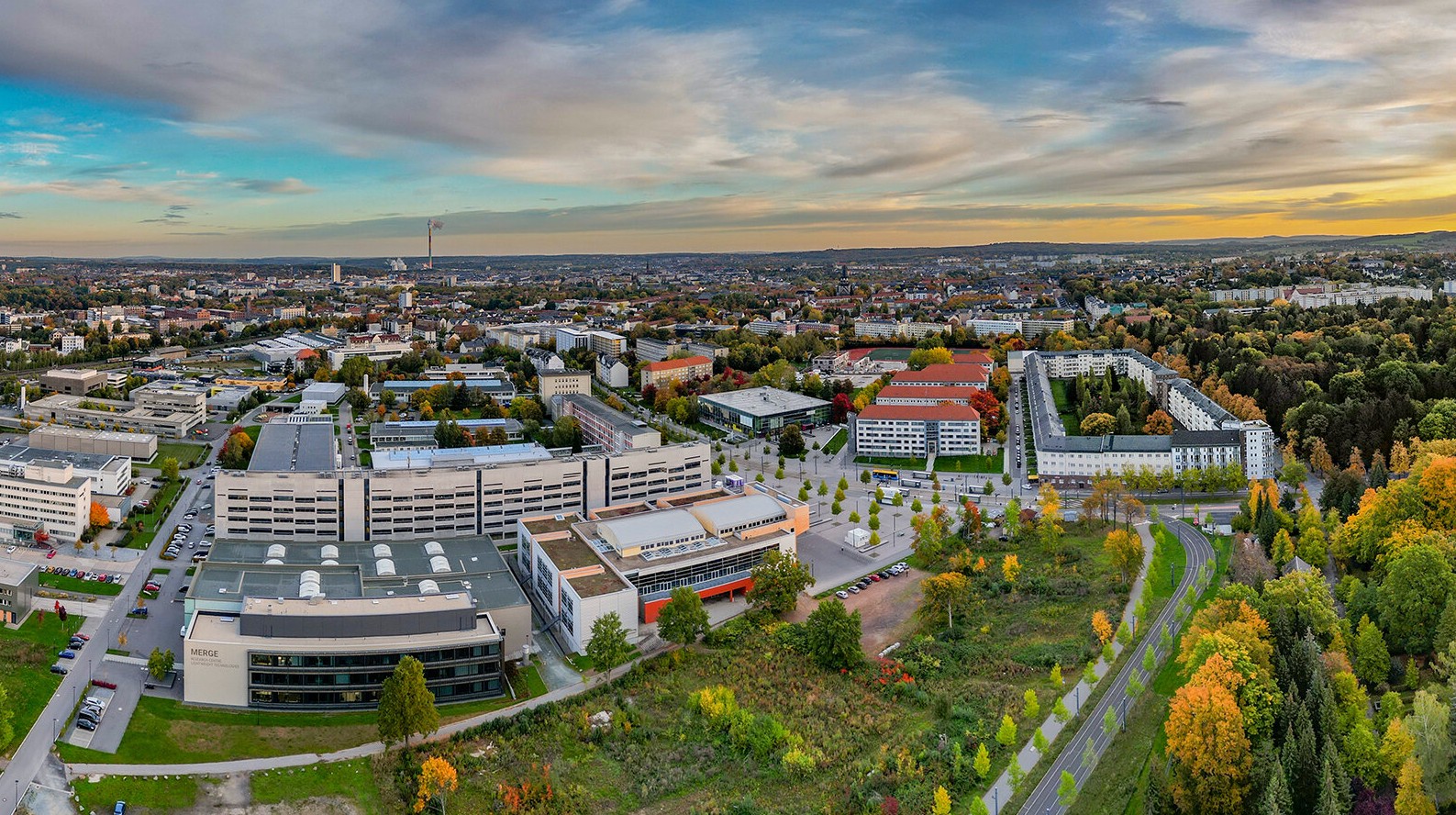
Technische Universität Chemnitz
Zentrales Hörsaal- und Seminargebäude, C10
Reichenhainer Str. 90
09126 Chemnitz
Germany
How to get there
By train:
Visit Deutsche Bahn to find a train connection to Chemnitz Hbf.
By plane:
The closest international airport is Leipzig/Halle Airport. The airport has a train station, and there are regular connections to Chemnitz Hbf.
Local:
You can reach the conference venue conveniently by Tram Lines 3, C13, C14 and C15.
Exit the Tram at the station "TU Campus".
Local transportation in Chemnitz is operated by CVAG.
You can purchase tickets both digitally and in person on busses, trams and machines on some stations.
A digital ticket can be purchased through various apps, for instance, the DB Navigator App.
Here you can find an overview over the prices.
Once you are there
Please follow the maps
Room C10.001 and
Campus Map Reichenhainer
to find the room.
Last updated in March 2026.
This is a subdomain of /tobiasmetzlaff.com hosted by All-Inkl via FileZilla.
To contact the responsible owner, please find the relevant information on the top right.
|
|
|
|
|
|